Cifral Custom / Industrial quotation workflows
Quote faster.Bid more.Keep engineers on engineering.
From RFQ to a technical proposal draft in minutes. Cifral prepares requirements, flags gaps and assembles your offer around your data and rules. Your team reviews the engineering, approves the price and decides what goes to the customer.
Illustration: an RFQ email, a specification, a layout drawing and a pricing spreadsheet feed a Cifral workflow that structures requirements, flags missing information, tracks internal inputs and prepares an estimate and a proposal draft. Engineering review, pricing approval and final approval stay with your team.
The quotation workflow problem
Most of the delay is not engineering. It is the work around it.
Every technical quotation needs engineering judgement. Much of the effort, though, goes into searching, chasing and re-keying.
- Fwd: RFQ, sortation expansion3 attachments
- Specification_rev3.pdf42 pages
- Pricing_v7_FINAL.xlsxLast edited by one person
- PurchasingAny update on the drive lead times?
- Layout_DC2.dwgrev C
- Peak throughput not specifiedFound on day 4
- Bid due Friday17:00
Where Cifral can automate
One quotation workflow. A human decision at every stage.
Four areas, one or several in scope. Each shows what comes in, what Cifral prepares or checks, and what your team decides.
Covers
- RFQ intake
- Requirements
- Technical information
- Missing information
What comes in
RFQ emails, PDFs, drawings and specifications
What Cifral can prepare or check
Structures the request, retrieves approved references and flags what is missing
What your team decides
Validates the interpretation and decides what to ask
Covers
- Internal inputs
- Estimation
- Pricing rules
- Coordination
What comes in
Cost data, spreadsheets, price lists and answers from other teams
What Cifral can prepare or check
Routes requests, tracks owners and applies your agreed cost and pricing rules
What your team decides
Owns assumptions, margins and committed prices
Covers
- Approval
- Proposal preparation
- Quality checks
- Review
What comes in
Approved scope, price and reusable content
What Cifral can prepare or check
Prepares the approval summary, assembles a draft and checks it against agreed criteria
What your team decides
Approves, edits and gives final approval
Works with
- Documents
- CRM / ERP
- APIs
- Databases
- Custom workspace, where useful
What comes in
The systems your team already uses
What Cifral can prepare or check
Reads from them and writes back where access and feasibility allow
What your team decides
Decides which systems are in scope and what access is granted
Understand the requestIntake, requirements, gaps
Covers
- RFQ intake
- Requirements
- Technical information
- Missing information
What comes in
RFQ emails, PDFs, drawings and specifications
What Cifral can prepare or check
Structures the request, retrieves approved references and flags what is missing
What your team decides
Validates the interpretation and decides what to ask
Build the quotationInputs, estimate, pricing
Covers
- Internal inputs
- Estimation
- Pricing rules
- Coordination
What comes in
Cost data, spreadsheets, price lists and answers from other teams
What Cifral can prepare or check
Routes requests, tracks owners and applies your agreed cost and pricing rules
What your team decides
Owns assumptions, margins and committed prices
Prepare and reviewApproval, proposal, checks
Covers
- Approval
- Proposal preparation
- Quality checks
- Review
What comes in
Approved scope, price and reusable content
What Cifral can prepare or check
Prepares the approval summary, assembles a draft and checks it against agreed criteria
What your team decides
Approves, edits and gives final approval
Connect the processYour existing systems
Works with
- Documents
- CRM / ERP
- APIs
- Databases
- Custom workspace, where useful
What comes in
The systems your team already uses
What Cifral can prepare or check
Reads from them and writes back where access and feasibility allow
What your team decides
Decides which systems are in scope and what access is granted
Start small
Start with one bottleneck. Expand when it creates value.
You do not need to replace your quotation process or automate all of it. Most work starts with the one stage that consumes the most engineering time.
Understand the current quotation workflow
How requests arrive, where information lives, who estimates and who approves.
Identify one meaningful bottleneck
The stage where repetitive work consumes the most engineering or sales-engineering capacity.
Build a focused first implementation
Around your tools, data and business rules, with agreed outputs and approval points.
Connect additional stages only when useful
Once the first workflow has proved useful, and only where another stage adds value.
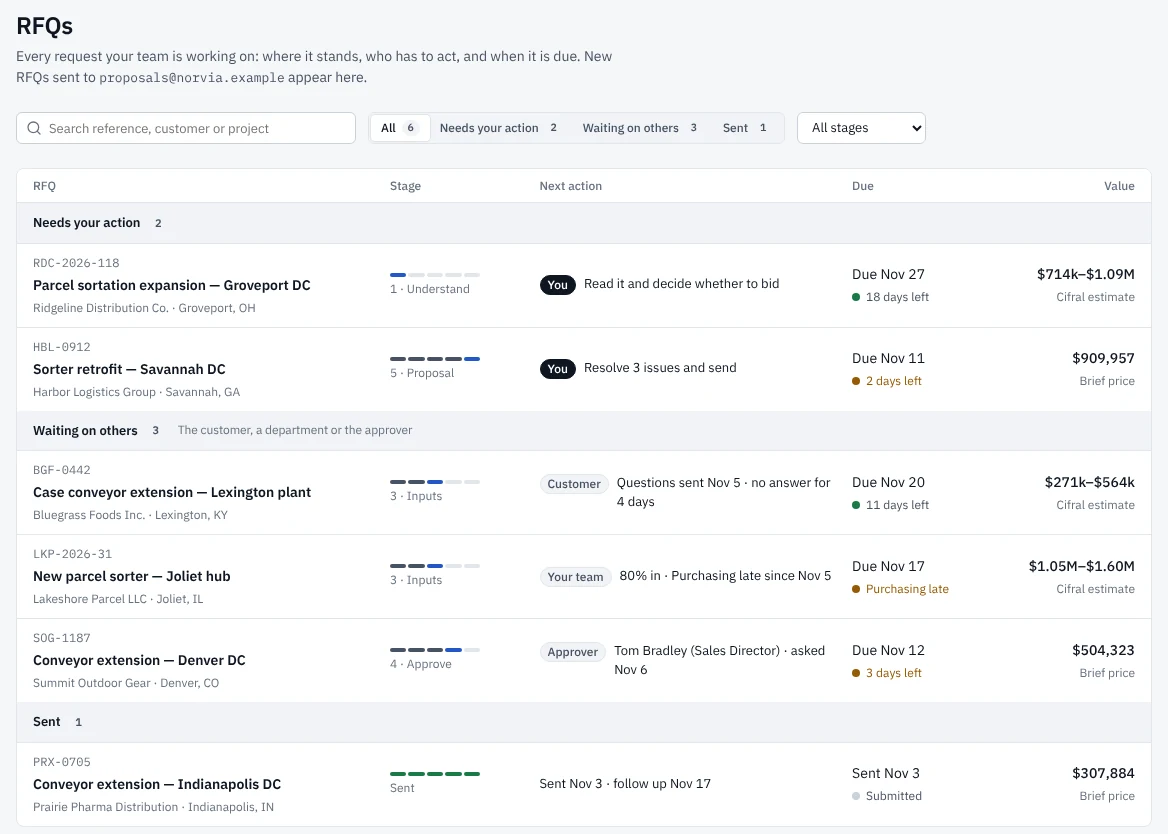
Illustrative scenarios
Where quotation workflows get stuck.
Three illustrative scenarios, not customer results. Your bottleneck may look different.
RFQ intake and missing information
Cifral structures the request and flags gaps; engineers decide what to ask.
Read the scenarioEstimation, pricing and internal inputs
Cifral applies agreed rules and tracks inputs; your team owns assumptions and prices.
Read the scenarioProposal assembly and review
Cifral assembles a draft from approved content and checks it; your team approves.
Read the scenario

Experience
Built from years of experience in industrial Sales Engineering.
Firsthand experience preparing hundreds of industrial technical proposals shapes how we work: understand the quotation workflow first, then automate what is repetitive.
QuoteGenSimple line-item quotes? QuoteGen is our separate self-service product.
Explore QuoteGenYour next step / Cifral Custom
Show us how a quotation moves through your team.
In 30 minutes, we walk through a typical quotation, identify the repetitive work and assess a useful first stage to automate, including what it would prepare for your team.
What we cover
- How a quotation moves through your team today.
- Where repetitive work consumes engineering capacity.
- The main bottleneck, and whether a first workflow is worth automating.
Sometimes the honest conclusion is that there is no practical first workflow to automate yet. That is a useful answer too.